

why the most serious security risks rarely look dangerous to the public eye
By Dwamba’s
The Lawrence Muganga controversy has been argued in Uganda as though it were only a fight over citizenship papers, parliamentary politics, or personal identity. That reading is too narrow. The deeper significance of the affair lies in what it says about how states miss danger when danger arrives wearing the right suit, speaking the right language, and entering through respectable doors.
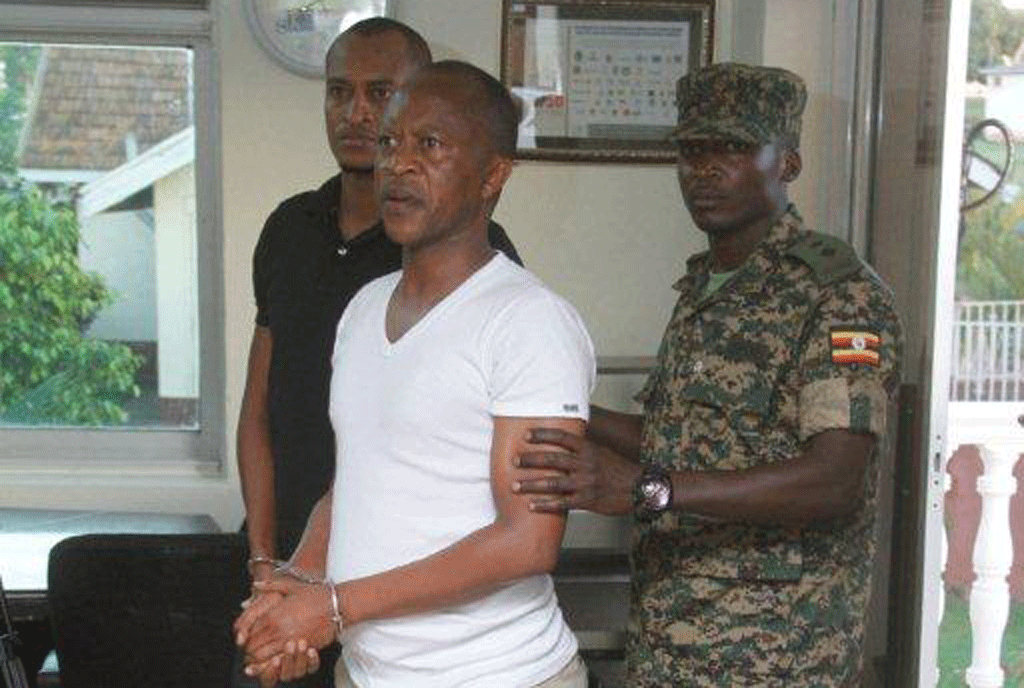
By June 2026, Uganda’s Appointments Committee had withheld approval of Muganga’s nomination as State Minister for Internal Affairs over unresolved questions linked to dual citizenship. Public reporting also revived the memory of his 2021 arrest by joint security forces on allegations of espionage and unlawful stay, though he was later released without prosecution. None of that, by itself, proves guilt. Yet in security affairs, the most important question is often not whether a crime has already been proved in court, but whether a pattern of unresolved risk has been normalised by the political class.
That distinction is often lost on lay observers. Ordinary citizens tend to assume that intelligence blunders look dramatic: coded radios, dark glasses, forged passports, midnight arrests. In reality, the great intelligence failures of history have usually looked ordinary until it was too late. Their common feature is not theatrical secrecy, but misplaced confidence.
The most dangerous infiltrations are not the ones a public crowd can easily spot. They are the ones respectable people help to legitimise.
The public lens asks simple questions. Is the person educated? Are they eloquent? Have they held impressive jobs? Do they sound patriotic? Do powerful people seem comfortable around them? The security lens asks different ones. What remains unverified? What contradictions have been waived aside? Which red flags have been explained away because the individual is useful, connected, or politically convenient? Who is taking responsibility for access if the decision later proves disastrous?
Seen through that second lens, Muganga’s case becomes more consequential. The ministry to which he was nominated is not ceremonial. Internal Affairs sits close to the nerve centre of state control: immigration, citizenship, national identification systems, borders, passports, refugee administration, and internal coordination. When unresolved citizenship questions, foreign ties, and prior security allegations gather around a nominee for such an office, the issue ceases to be personal. It becomes institutional.
The classic illustration remains Eli Cohen, the Israeli spy who penetrated the upper reaches of Syrian power in the 1960s. Cohen did not conquer Syria with weapons. He entered by becoming Kamal Amin Thaabet, an apparently successful Syrian businessman, then built intimacy with influential men who brought him into elite circles. He won access because he looked plausible, sounded plausible, and was vouched for by people who considered themselves good judges of men.
This is what lay audiences often miss when they hear the Cohen story. The real scandal was not merely that a spy existed. States always assume spies exist. The scandal was that the social gatekeepers of the Syrian system mistook familiarity for proof. Cohen’s greatest operational success was not transmitting intelligence. It was becoming a man whom important people stopped checking.
That is why the Muganga debate cannot be dismissed as overreaction. No responsible state waits for a spectacular disaster before treating patterns seriously. A mature security culture asks hard questions before sensitive access is granted, not after institutions have been embarrassed.
History offers other warnings. Kim Philby, one of the most damaging Soviet agents of the Cold War, rose within British intelligence not because Britain lacked intelligence officers, but because its establishment trusted the signs it was socially trained to trust: breeding, education, connections, composure. He exploited class confidence as effectively as tradecraft. By the time his betrayal was fully appreciated, he had already helped wreck operations and expose agents.
Jonathan Pollard exposed a different kind of blindness in the United States. He was not an exotic outsider. He was an insider with clearance, access, and colleagues who kept overlooking warning signs. Later commentary on the case stressed how obvious some of those signals had been. But bureaucracies often reinterpret danger when the person involved appears productive, useful, or ideologically intelligible. Institutions become complicit in their own deception when they choose convenience over discipline.
The common lesson from Cohen, Philby, and Pollard is not that every controversial appointment hides a spy. It is that the line between negligence and cover-up is often thin. Sometimes officials consciously suppress awkward facts to avoid political embarrassment. Sometimes they merely delay action, dilute language, or rely on procedural fog until the public loses interest. In both cases, a problem that should have been managed early becomes harder to confront honestly.
To the lay public, a cover-up sounds like a dramatic conspiracy. In practice, it usually looks mundane. A file is said to be incomplete. A verification is said to be pending. A prior arrest is dismissed as a misunderstanding. A sensitive question is rebranded as prejudice. A legal issue is reframed as a political attack. The object is not always to prove innocence. Often it is simply to create enough ambiguity to keep the machine moving.
That possibility matters in the Muganga matter because the public facts do not point to a clean and tidy narrative. There was a prior security arrest. There were questions over nationality and renunciation. There was a nomination to a ministry that governs the machinery of identity and internal order. There were also public claims of bias and xenophobia from Muganga’s side after the vetting dispute. Each point can be argued separately. The real security concern lies in their accumulation.
The most important question, therefore, may not be whether the nominee has defenders. Every controversial figure has defenders. The real question is whether Uganda’s institutions have standards strong enough to function independently of defenders. A sovereign state cannot organise security around sentiment, friendship, usefulness, or ethnic solidarity. It must organise security around verifiable fact.
There is another uncomfortable truth that security professionals understand better than the general public. The greater risk is often not the outsider, but the insider who opens the door. Intelligence blunders frequently begin with sponsors, brokers, patrons, and certifiers — people inside the system who make access appear safe. When a questionable figure gets close to a sensitive office, attention naturally settles on the individual. Yet history suggests that the more revealing story may be about the people who recommended, excused, or fast-tracked that individual.
This is why the Muganga story should worry serious Ugandans even if they believe he has done nothing unlawful. The affair tests the integrity of the gatekeeping process itself. Who checked what, and when? Who was satisfied with incomplete answers? Which agencies were consulted? Were earlier allegations treated as noise because they were inconvenient to a preferred appointment? Those are not partisan questions. They are state questions.
A new detail reportedly emerging from Parliament deepens the matter further: that Muganga entered the vetting committee with recording materials and used them to capture the proceedings. If that account is accurate, it is not a minor side issue. It raises a fresh question about intent, judgment, and the instinct to collect sensitive institutional exchanges from within a controlled state process.
To an ordinary reader, the act may look clever, defensive, or even merely opportunistic. To a security-minded institution, it looks different. Unauthorised recording inside a high-level vetting environment suggests a willingness to bypass procedural trust, preserve private deliberations for later leverage, and convert a confidential state setting into a personal archive. Even before any discussion of law, that behaviour is itself revealing.
This is why security services should take interest. The issue is not only what was recorded, but what the act demonstrates about disposition. In intelligence and counterintelligence analysis, capability is often inferred from conduct. A person who enters a sensitive screening room with covert or undeclared recording tools is demonstrating initiative, concealment, and a readiness to extract value from restricted spaces. Those are not neutral traits when the office in question concerns Internal Affairs.
It also changes the meaning of Muganga’s later claim that he possessed audio material suggesting that the outcome of the vetting had been predetermined. Public reporting indicates that he alleged he had audio evidence and intended to release it. If that material was obtained by recording inside the committee process, then the public debate should not focus only on what he says the audio proves. It should also focus on how the audio was obtained, why he thought it proper to obtain it, and whether Parliament’s own security controls were sufficiently alert to stop such conduct before it happened.
Viewed through the wider history of intelligence blunders, this detail is significant because many institutions ignore small procedural breaches when they are attached to a charismatic, articulate, or politically useful figure. Yet minor breaches are often the most honest signals. They expose habit. They show how a person behaves when placed inside a restricted environment. In that sense, the alleged recording is not a footnote to the Muganga story. It may be one of its clearest indicators.
The uncomfortable possibility is that a lay audience may interpret such conduct as evidence of sophistication, while a security audience interprets it as evidence of risk. Those two interpretations are not the same. One admires tactical boldness. The other asks whether a person seeking a sensitive state office has already shown a willingness to privately capture protected proceedings for personal use, narrative warfare, or future pressure. That is exactly the kind of behavioural clue a serious sovereign state is expected to notice early.
Uganda should learn two lessons at once. The first is encouraging: Parliament’s vetting system appears, at least in this instance, to have acted as a constitutional brake on a sensitive appointment clouded by unresolved issues. The second is sobering: the matter reached that stage at all. A state that takes sovereignty seriously should not discover foundational problems only at the last moment of public controversy.
The wiser response is neither hysteria nor tribal defensiveness. It is institutional seriousness: earlier background checks, firmer citizenship verification, unified security records, and a stricter culture of accountability for those who sponsor appointments into sensitive offices. That is how mature states reduce the space in which blunders become scandals and scandals become cover-ups.
The Muganga affair is therefore bigger than Muganga. It is a warning about how modern states can be weakened not only by hostile actors, but by ordinary habits of elite indulgence. The public may see a citizenship quarrel. The sharper lens sees something else: a test of whether Uganda can tell the difference between reputation and proof, access and loyalty, comfort and security.