

THE SOVEREIGN REVIEW | SPECIAL COMMENTARY
PART TWO
The Amplifier in the Room
By Dwamba’s
I. A Voice Demanding Attention
When a public figure stands before cameras and warns that a country should prepare itself for M23 if a political demand is not met, that statement does not belong to the register of ordinary commentary. M23 is not a theoretical concept. It is a war formation synonymous with massacres, forced displacement, and the violent redrawing of territorial boundaries in eastern Congo. The invocation of its name as a threat inside Uganda’s own political conversation deserves to be treated with the seriousness the language itself demands.
The man who issued that warning was Frank Gashumba, the Kampala based businessman, social commentator, and chairman of the Council for Abavandimwe. In February 2026, well before the Muganga vetting controversy reached its peak, Gashumba made the statement explicitly: if the question of Banyarwanda recognition is not resolved, prepare yourself for M23 in Uganda. Those words did not appear in a private room. They were broadcast, amplified, and documented on social media and news platforms. Whether framed as a warning, a prediction, or a threat, the effect is the same: a prominent Ugandan figure linked his community’s political grievances to a specific armed rebellion template, and the national conversation largely moved on as though nothing of particular consequence had been said.
That normalisation is precisely what should concern a security state. In the weeks that followed, Gashumba intensified his public campaign in defence of Lawrence Muganga’s nomination as State Minister for Internal Affairs, framing the vetting controversy as racial discrimination and xenophobia. He positioned himself as a protector of a victimised community. Yet the question this article raises is different: who is Frank Gashumba, and what does his own record reveal to a security conscious eye?
II. *The Profile the Public Tends to Miss*
Frank Malingumu Gashumba was born on 3 December 1974 in Villa Maria, Masaka District. His parents were of Rwandan origin, his grandparents having moved from Rwanda to Uganda in 1923. He attended school in Masaka, later graduated from Nkumba University with a degree in Business Administration, and built a business network described under the Mali Group of Companies, with declared interests in agriculture, transport, mineral exploration, and tourism. He chairs the Council for Abavandimwe, serves as Vice Chairman for the Central Region of the Patriotic League of Uganda, and operates companies including Bbunda Holdings, which is reportedly engaged in gold and timber trade in the Democratic Republic of Congo.
Gashumba is articulate, well-connected, media savvy and publicly visible. He has appeared in newspapers, television studios, YouTube channels and TikTok. He speaks with the confident register of a man whose access to powerful people appears assured. And therein lies the first parallel worth drawing. The profiles of individuals who become vectors of institutional risk often begin this way: legitimate presence, real connections, genuine grievances to champion, and a public platform that makes scrutiny feel like persecution.
The lay public sees a businessman and activist. The security eye is trained to look at something else, the pattern.
III. *The Record That Speaks for Itself*
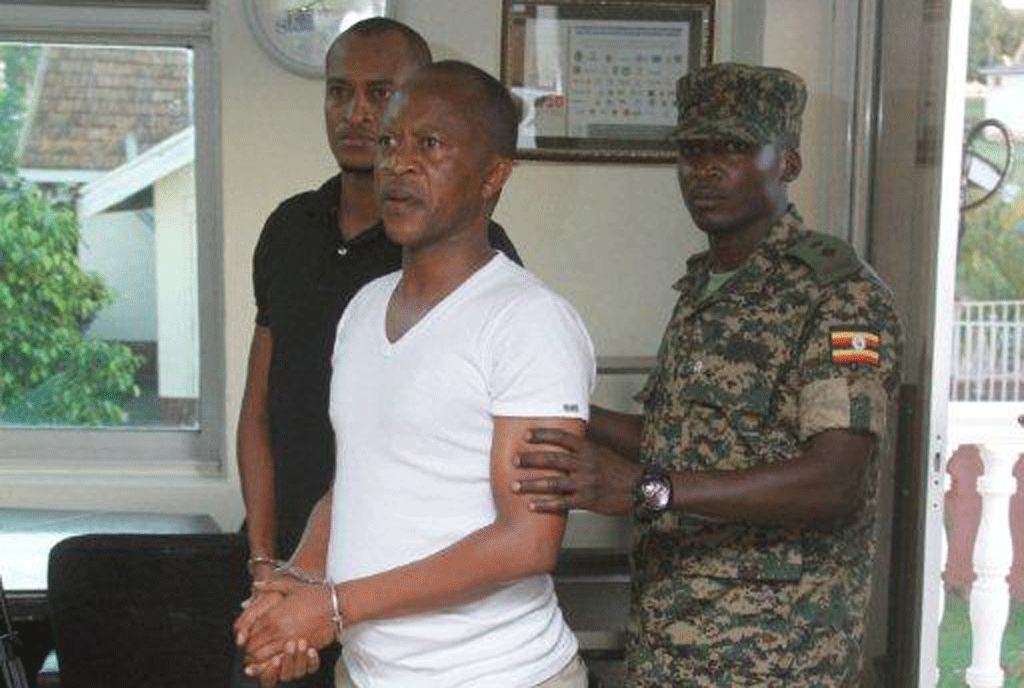
In October 2017, the Chieftaincy of Military Intelligence arrested Gashumba and paraded him before the press. The allegation was not trivial. He and his brother Innocent Kasumba were accused of impersonating senior Ministry of Defence officials specifically a Director of Logistics and a Director of Procurement to defraud foreign nationals. A deal reportedly worth twelve million dollars had allegedly been arranged under a fictitious company called Flagship Group, presented to investors as a legitimate Ministry of Defence contract for supplying military trucks, water tanks, and heavy machines to Uganda.
When CMI searched his premises, they found multiple passports in varying identities and stamps for forging South Sudan government ministries. Sixteen charges followed, including forgery, impersonation, conspiracy to commit a felony, and unlawful possession of narcotic drugs. The prosecution eventually failed to produce witnesses, and the Buganda Road Court dismissed the charges in November 2019. That procedural outcome determined the legal verdict. It did not erase the substance of what was found.
This was not the beginning of Gashumba’s troubles with the state. In 2013, the Directorate of Criminal Investigations had examined him on nearly identical allegations involving impersonation of defence officials to defraud a Turkish company, an investigation whose findings were never published. In 2021, he was arrested again in connection with a fire tender fraud involving foreign investors. And in 2016, complainants came forward alleging he had collected money from unemployed graduates for overseas placements that never materialised.
Multiple passports across different identities. Repeated impersonation of defence officials over nearly a decade. Serial allegations of defrauding foreign nationals under false institutional authority. An established method of using the apparatus of the state,its uniforms, seals and titles to manufacture credibility. No conviction followed any of these episodes. That fact must be acknowledged. A security analysis, however, is not a criminal trial. Its task is to assess patterns of behaviour and the risk those patterns represent to the institutions a person seeks to access or influence.
IV. *The M23 Statement and What It Actually Signals*
When Gashumba warned that Uganda should prepare for M23, he was not speaking abstractly. The statement came in the context of an extended political campaign directly linked to the community that would later produce Muganga’s nomination. The Council for Abavandimwe had been pressing government on Banyarwanda citizenship documentation, had met President Museveni, had secured executive commitments, and had publicly aligned itself with Dr. Lawrence Muganga, who sat alongside Gashumba in those community gatherings and echoed the same grievances.
Analysts who examined the M23 statement noted immediately that it did not merely invoke a rebellion in the abstract. Gashumba tied it to a scenario of recognition and land, the same ideological framework identified as the engine of the M23 project in eastern Congo. One regional commentator framed it plainly: what starts with administrative demands and ends with threats of M23 and land annexation is the beginning of the infernal cycle that destroyed eastern Congo. That cycle follows a familiar sequence: a diaspora community’s legitimate grievances are organised by political advocates, the rhetoric escalates to territorial claims, and an armed formation eventually emerges as the implied guarantor of those claims.
Gashumba subsequently softened the edges of his statement in some forums. But the words had been recorded, shared, and studied. In security analysis, statements of this nature from organised community leaders with networks across borders are not assessed only at face value. They are assessed for what they reveal about the speaker’s reference points, their audience, and the conditions under which they believe escalation is justified.
V. *The Gashumba-Muganga Network*
The connection between Frank Gashumba and Lawrence Muganga is not incidental. They share a platform, a political identity, and a pattern of advocacy that culminated in Muganga’s presidential nomination to the most sensitive ministry in Uganda’s domestic governance structure. The two men appeared together at the January 2025 Council for Abavandimwe gathering at Speke Hotel in Kampala. Muganga echoed Gashumba’s framing of systematic discrimination. Gashumba celebrated Muganga’s nomination and led the public defence when vetting went wrong.
When the Appointments Committee withheld approval over dual citizenship, Gashumba did not offer measured solidarity. He weaponised the moment. He reframed a constitutional and security question as tribal persecution, invoked xenophobia, amplified claims of prejudice, and created enough political noise to make the institutional process look like a witch-hunt. That is a recognisable playbook. It is the same playbook used to protect every controversial figure whose credentials cannot survive scrutiny: reframe legal standards as bias, personalise institutional concerns as hatred, and make the system blink.
What lay observers saw in June 2026 was a debate over passports and parliamentary procedure. What a security analyst sees is a coordinated network: a community advocate with a troubled security record, an academic nominee with unresolved espionage allegations, a shared advocacy platform demanding access to the ministry that governs citizenship and internal security infrastructure, and a threat of armed rebellion as the political backdrop. These are not coincidences to be dismissed. They are connective tissue.
VI. *How Influence Operations Actually Work*
The phrase intelligence infiltration conjures images that bear little resemblance to how modern influence operations actually function. States and networks that seek to penetrate a sovereign government rarely send agents with forged papers and hidden transmitters. They send advocates. They organise community grievances. They position credible, passionate, genuinely local figures in civil society, media, and ultimately in government. They create spokespeople who are of the community, who fight real battles, and whose sincerity is impossible to question on the surface.
Frank Gashumba may be exactly what he presents himself to be: a passionate, sometimes reckless community leader who fights hard for people he believes are marginalised. That reading is possible, and it deserves acknowledgment. But a state cannot organise its national security around the most charitable interpretation of every public figure who campaigns for access to its most sensitive institutions. The record demands scrutiny. A man of Rwandan descent, with multiple passports in different identities seized by military intelligence, with a history of impersonating defence officials, with business interests in an active conflict zone, with a documented threat of M23 style rebellion and with a direct and sustained alliance with the individual being pushed for Uganda’s internal security ministry.
The history of intelligence blunders teaches the same lesson again and again. It is not the operative who creates the vulnerability. It is the trusted network around the operative. The Syrian officials who vouched for Eli Cohen. The MI-6 establishment that promoted Kim Philby. The Naval supervisors who restored Jonathan Pollard’s clearances. In each case, the enabling mechanism was social architecture: a circle of influence that made scrutiny feel impolite and belonging feel like proof.
VII. *Questions a Sovereign State Must Ask*
This article makes no claim that Frank Gashumba is a foreign agent. It makes no claim that Lawrence Muganga is a spy. Those are determinations for intelligence services and courts, not for newspapers. What this article argues is something more specific: the accumulation of public facts around these two men and the network they share, presents Uganda with a set of questions that a serious sovereign state cannot responsibly dismiss as political noise.
Who finances the Council for Abavandimwe, and through what channels? What are the full business interests of Bbunda Holdings in a country like the DRC where armed conflict intersects directly with the political rhetoric Gashumba has employed? Why did CMI find multiple passports in different identities when they searched Gashumba’s premises? Why does a man with that record lead the loudest campaign defending a nominee for the ministry that controls Uganda’s national identification infrastructure? Why was a threat of M23 style rebellion met with no formal institutional response? And who, in each episode, opened the door?
Those are not partisan questions. They are not questions about ethnicity. They are questions about institutional integrity, access control, and the willingness of a sovereign state to apply the same verification standards to politically connected figures that it applies to everyone else. The Ministry of Internal Affairs controls biometric registries, citizenship databases, border management systems and internal intelligence coordination. It is not an administrative inconvenience. It is a nerve centre. The people who govern it must have passed through a gate that no community rally, media campaign, or accusation of discrimination can substitute for.
VIII. *The Enduring Lesson*
There is a thread running through the Muganga affair and through the Gashumba affair that connects both to the wider pattern this commentary series has been examining. In every major intelligence blunder, the warning signs existed. They were visible, documented, and available to the people whose job it was to act on them. The failure was not informational. It was institutional: the failure of systems and individuals to act on what they already knew, because acting was inconvenient, politically costly, or socially uncomfortable.
Uganda’s particular temptation runs through ethnic solidarity and the politics of victimhood. To some Banyarwanda like other communities may be facing genuine bureaucratic injustices and those injustices must be addressed through law and policy. President Museveni has himself affirmed that commitment. But the existence of genuine discrimination does not immunise every actor who claims to fight it. The advocate and the network around the advocate must be subject to the same scrutiny as anyone else seeking access to the architecture of the state.
The Muganga affair was the visible chapter. The Gashumba dimension, if Uganda’s security institutions are applying the right lens, is the chapter that explains the context. Together, they raise a question that no serious state should leave unanswered: when a community advocacy network, led by a figure with a documented history of multiple identities and impersonation of defence officials, campaigns loudly for its chosen nominee to run the ministry that controls national identity and backs that campaign with threats of an armed rebellion model, what exactly is Uganda being asked to ignore, and who is being asked to look away?
That is the state question. The public deserves to know the answer.
This article is Part Two of an ongoing newspaper commentary series. It relies on publicly documented information and does not constitute legal findings against any individual.
Dwamba’s | The Sovereign Review